828 NE A St, Grants Pass, OR 97526

What Are Inlays and Onlays?
Not every damaged tooth needs a filling, and not every damaged tooth needs a crown. Inlays and onlays fill the space in between, offering a custom-made restoration for teeth that have more decay or damage than a standard filling can handle, but not so much that the entire tooth needs to be covered. Instead of being shaped directly in your mouth like a filling, an inlay or onlay is crafted outside the mouth, typically from porcelain, composite resin, or gold, then bonded permanently into place.
At A Street Dental in Grants Pass, we recommend inlays and onlays for patients throughout Southern Oregon, including Josephine County, Myrtle Creek, Canyonville, Selma, and communities along the coast, whose tooth damage falls into that middle ground, where a filling would be too weak to hold up long-term, but a full crown would mean removing more healthy tooth structure than necessary. It's a more conservative approach that still delivers the strength and durability you need for everyday chewing.
Schedule a Consultation
Difference Between Inlays and Onlays
Since inlays and onlays are often mentioned together, it helps to know exactly what sets them apart.
Inlays
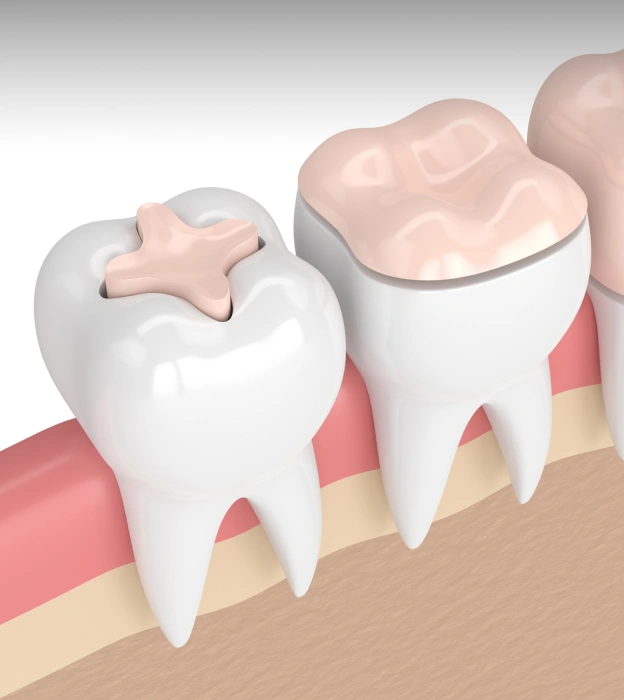
Used when decay or damage is limited to the area between the cusps of a tooth, an inlay fits neatly into that space without covering any of the cusps themselves. This is typically the right choice for moderate decay that a filling can't fully address.
Onlays
Sometimes called a partial crown, an onlay is used when the damage extends to one or more of the tooth's cusps. Rather than covering the entire tooth as a crown would, an onlay reinforces just the affected area, leaving the rest of the healthy tooth structure untouched.
Which one you need depends entirely on the extent of the damage, something we'll determine with an exam and X-rays before recommending a treatment plan.
Benefits of Choosing an Inlay or Onlay
Inlays and onlays offer a few real advantages over the two more familiar options on either side of them:
- More Conservative Than a Crown: Because only the damaged portion of the tooth is removed, significantly more of your natural tooth structure stays intact.
- Stronger Than a Large Filling: For damage too extensive for a standard filling, an inlay or onlay provides better long-term strength and resistance to further cracking or wear.
- Custom Fit: Since each restoration is crafted outside the mouth from an impression, the fit, shape, and bite are more precise than what's achievable with a filling placed directly in the mouth.
- Natural Appearance: Porcelain and composite inlays and onlays are shaded to match your natural tooth color, so the restoration blends in rather than standing out.
Caring for Your Inlay or Onlay
An inlay or onlay is built to hold up to everyday use, but a little care goes a long way toward making it last. Here's what helps:
- Brush and floss around the restoration just as you would a natural tooth, since decay can still develop at the edges if plaque builds up.
- Avoid biting down on very hard foods or objects, like ice or hard candy, which can chip or dislodge the restoration.
- Keep up with your regular six-month checkups so we can check the fit and catch any wear early.
- Let us know if the tooth ever feels different when you bite down, since that can be a sign the restoration needs an adjustment.
Ready to Repair a Damaged Tooth?
If a cavity or old filling has left one of your teeth weaker than it should be, an inlay or onlay may be the right fix without the need for a full crown. Reach out to our team today, and we'll take a look and walk you through your options.
Schedule Your Visit Online